


About eBooks:
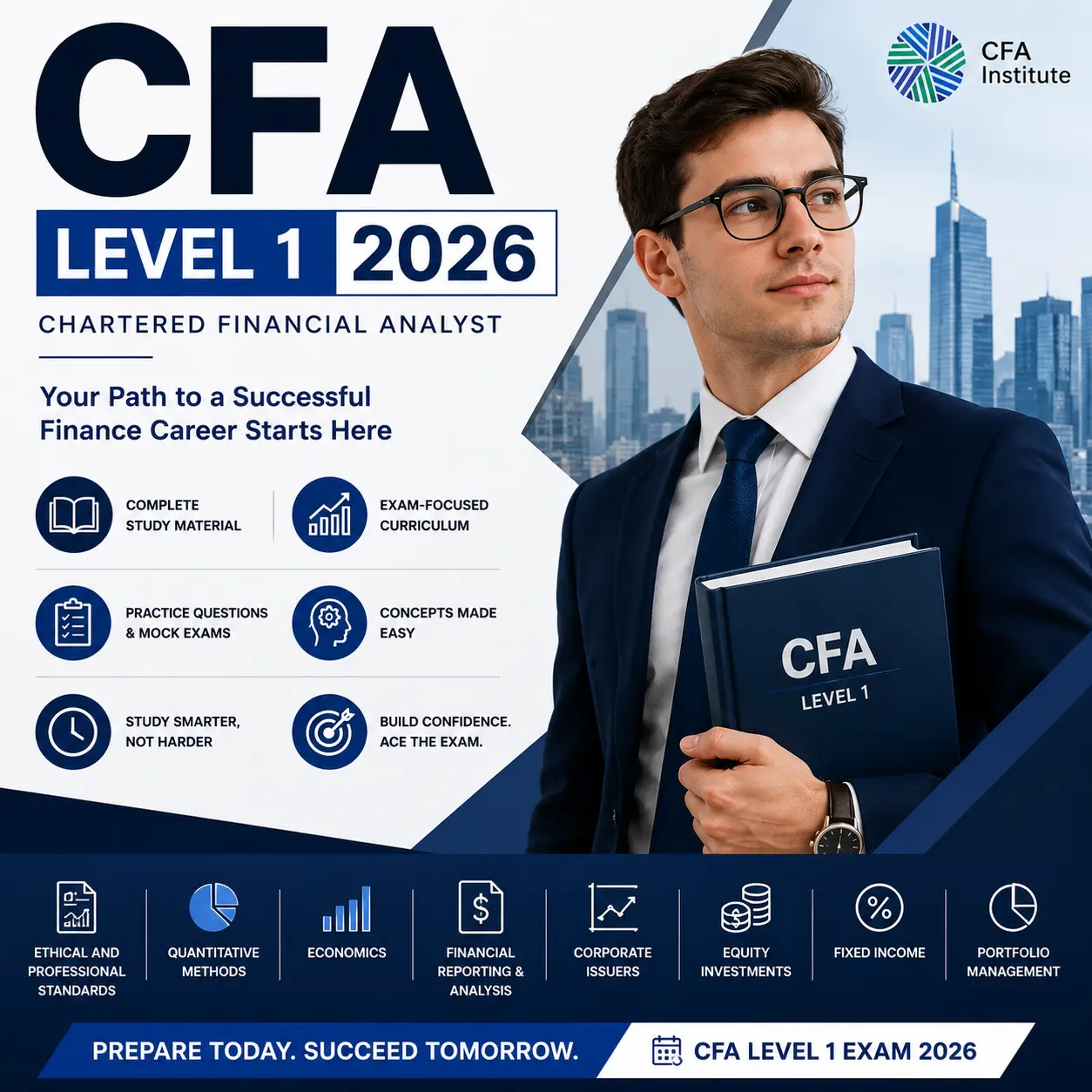
Designed for aspiring financial analysts, portfolio managers, and investment professionals, this course provides a deep foundation in core financial concepts. The 10-volume structure ensures detailed coverage of each topic, making it a rigorous yet rewarding learning experience.
What You Get:
- Ethical and Professional Standards
- Quantitative Methods
- Economics
- Financial Reporting and Analysis (FRA)
- Corporate Issuers
- Equity Investments
- Fixed Income
- Derivatives
- Alternative Investments
- Portfolio Management
CFA 2026 Level 1: 5 FAQs Every Candidate Should Read
1. Has the CFA Level 1 curriculum changed for 2026?
No — and that’s good news if you’re prepping right now. The 2026 CFA Level 1 syllabus is identical to 2025, with all 93 Learning Modules and 365 Learning Outcome Statements carried over unchanged. Topic weights across Ethics, Quantitative Methods, Economics, Financial Statement Analysis, Corporate Issuers, Equity, Fixed Income, Derivatives, Alternative Investments, and Portfolio Management stay exactly where they were.
What this means in practice: if you already own 2025 prep material (Kaplan Schweser, UWorld, Mark Meldrum, etc.), you can keep using it. You don’t need to spend extra money on “updated” 2026 editions just for curriculum coverage — the content hasn’t moved. This is the first year in a while without a major structural overhaul, so candidates retaking the exam get a real advantage: no re-learning, just refining.
2. What’s the CFA Level 1 2026 exam format, and how many questions are there?
The Level 1 exam is fully computer-based and split into two sessions of 2 hours 15 minutes each, with 90 multiple-choice questions per session — 180 questions total. Each question is standalone (no item sets at this level, unlike Level 2), and every question carries equal weight, so there’s no advantage to guessing strategically on “harder” ones — accuracy across the board matters equally.
You can take an optional break between sessions, and CFA Institute allows only two calculator brands: the Texas Instruments BA II Plus (including the Professional version) and the HP 12C. Bring backup batteries — you don’t get a replacement calculator on exam day.
3. When are the CFA Level 1 2026 exam dates, and how much does registration cost?
Level 1 runs four times in 2026: February, May, August, and November. The February and May windows have already passed. If you’re planning now, your live options are:
- August 2026: exam window August 18–24; standard registration deadline was May 6, 2026 (already closed for early pricing)
- November 2026: exam window November 11–17; standard registration deadline is August 11, 2026
On fees, 2026 brought a pricing shake-up: the old one-time $350 enrollment fee is gone entirely, even for first-time candidates. Instead, you pay a straight registration fee — $1,140 if you register early, or $1,490 at the standard rate. There’s also a new CFA Institute Access Scholarship with four application windows per year that cuts the total cost to $400 for candidates who qualify, so it’s worth checking your eligibility before paying full price.
4. How should I build a study plan for CFA Level 1 in 2026?
Since the curriculum didn’t change, your edge this year comes purely from how well you execute your prep, not from chasing new content. A few things that consistently separate passers from repeat candidates:
- Front-load Ethics and Quantitative Methods. They set up how you think through everything else, and Ethics questions show up throughout the exam, not just in one section.
- Weight your hours to topic weight, not to what feels comfortable. Equity, Fixed Income, and Financial Statement Analysis carry heavy weight — don’t shortchange them because Ethics or Derivatives feels more “learnable” fast.
- Shift to full-length, timed mocks in your final 4–6 weeks. Reading and re-reading notes plateaus quickly; question practice under real time pressure is what actually builds exam stamina for 180 questions across two sessions.
- Track your weak topics with a spreadsheet, not a gut feeling. Most candidates overestimate mastery in topics they’ve reviewed most recently and underestimate ones they haven’t touched in weeks.
Because 2025 materials remain 100% valid, if you’re retaking the exam, resist the urge to re-buy a full new package — put that budget into a mock-exam bank instead.
5. What’s the CFA Level 1 pass rate, and how is it scored?
CFA Institute typically reports Level 1 pass rates somewhere in the 35–45% range per sitting, though the exact number varies by exam window and isn’t announced until after results are released. There’s no fixed “70% to pass” rule — CFA Institute uses a standard-setting process each cycle, which is one reason candidates are told to focus on relative performance across topics rather than chasing a fixed score target.
A candidate-friendly detail: performance is reported by topic area on your score report (below 50%, 51–70%, or above 70% band), so even if you don’t pass, you get a clear signal on exactly where to focus for the next attempt instead of guessing.
View More Courses – Click Here



Reviews
There are no reviews yet.